That's usually where the idea of therapy quietly ends.
It can go another way. For most adults, online IFS therapy in Washington · telehealth works well with a private spot and a connection that mostly holds, as long as you're physically in the state when you meet. That's close to everything it asks of you.
TL;DR Quick Answers
Online IFS Therapy in Washington · Telehealth
Online IFS therapy in Washington is Internal Family Systems therapy over secure video, open to adults anywhere in the state. In small towns, where the nearest IFS-trained therapist can be hours away, it often feels more private than an office down the street.
Who it's for: adults who are physically in Washington during each session
What you need: a device with a camera, a door that closes, headphones, and a connection that mostly holds
How sessions run: 50 minutes on a HIPAA-compliant video platform
Cost: in-network with BCBS, Aetna, Regence, Premera, and Cigna, with a written Good Faith Estimate if you pay out of pocket
First step: a free 15-minute call with Lauren Rath, MA, LMHC
Top Takeaways
For most adults, it fits. A private spot and a connection that mostly holds are enough, as long as you're in Washington for each session.
IFS holds up over video. The work happens inside you, so the room around you matters less than people expect.
Privacy often gets better. Nobody sees your truck outside an office. Plan for a couple of weak spots, like insurance mail and thin walls.
Check before you commit. Look up the license with the Department of Health and the training with the IFS Institute.
Starting is small. One free 15-minute call tells you whether it feels right.
What Online IFS Therapy Actually Is
Internal Family Systems, or IFS, works with the different parts of you without picking a fight with any of them. The worried part, the part that pushes hard, whichever one shows up that day. Online IFS is the same work over secure video, from a room you pick.
You already talk this way. Part of me wants to go, part of me wants to stay home.
Richard Schwartz developed IFS, and the IFS Institute trains therapists in it. It's one form of talk therapy, though it spends less time analyzing your life and more time getting acquainted with what's going on inside it. Some parts protect you. They plan and perform and read the room before you've walked in. Others carry what happened, and they stay out of sight. Underneath both is what IFS calls Self, the steady, curious center a lot of people have lost track of.
None of that needs an office couch. The work happens inside you, which is a big part of why it holds up over a screen.
Why Small Washington Towns Feel The Gap First
Specialized therapists settle where the people are. In Washington, that means the I-5 corridor and Spokane. Colville, Omak, Forks, and Ellensburg might each have a general counselor or two and often nobody trained in IFS.
Most Washington counties carry a federal mental health shortage designation, and rural counties sit at the thin end of it. Waitlists can run long. When there's a drive, it eats half your day.
People who read this site already know that trade. Plenty of them fly in for a specialist worth traveling for because the right hands matter more than the miles. Therapy asks for something harder than one trip, though. It asks for the same hour every week, often for months, and telehealth is what keeps that going when the nearest IFS therapist lives on the other side of the Cascades.
Privacy In A Town Where Everyone Knows Your Truck
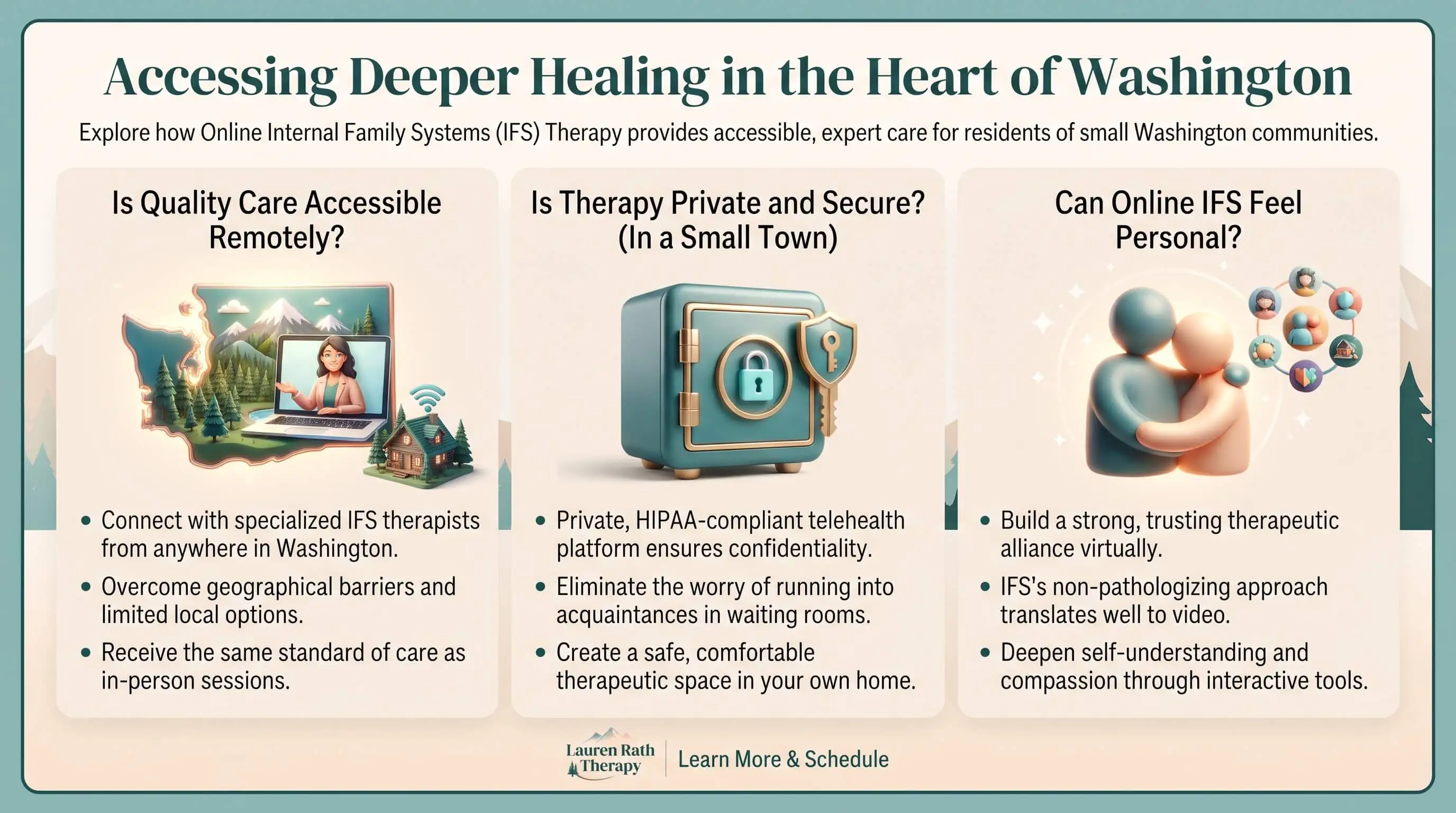
Online sessions take away the parts of starting therapy that get noticed in a small town, like the waiting room and the receptionist who went to school with your sister.
That matters in a place where news gets through the grocery line before it reaches the paper. What you say in a session is confidential wherever you go. The exposure tends to come from everything around the session.
Over video, you're the only one who sees yourself arrive. Sessions run on HIPAA-compliant platforms rather than FaceTime or a social app.
It isn't invisible, and it's worth being honest about that. An insurance statement can land in your mailbox. Someone in the next room might hear through a thin wall. Plan for both.
A parked car works as a therapy room more often than people guess. Headphones and a lower voice cover most of what's left.
What You Need At Home
Less than you'd think. A phone, tablet, or laptop with a camera, a door that closes, headphones, and a connection that mostly holds.
There's nothing special to install beyond the link your therapist sends.
If your internet comes and goes, as it does on plenty of ranch roads and peninsula towns, ask on the first call what happens when the video drops. Many therapists switch to a phone call to finish the hour. Sitting close to the router helps more than any upgrade, and a wired connection helps more still. Having IFS therapy explained during your consultation can also help you understand what to expect if technical issues interrupt your session.
Online IFS Or The Long Drive?
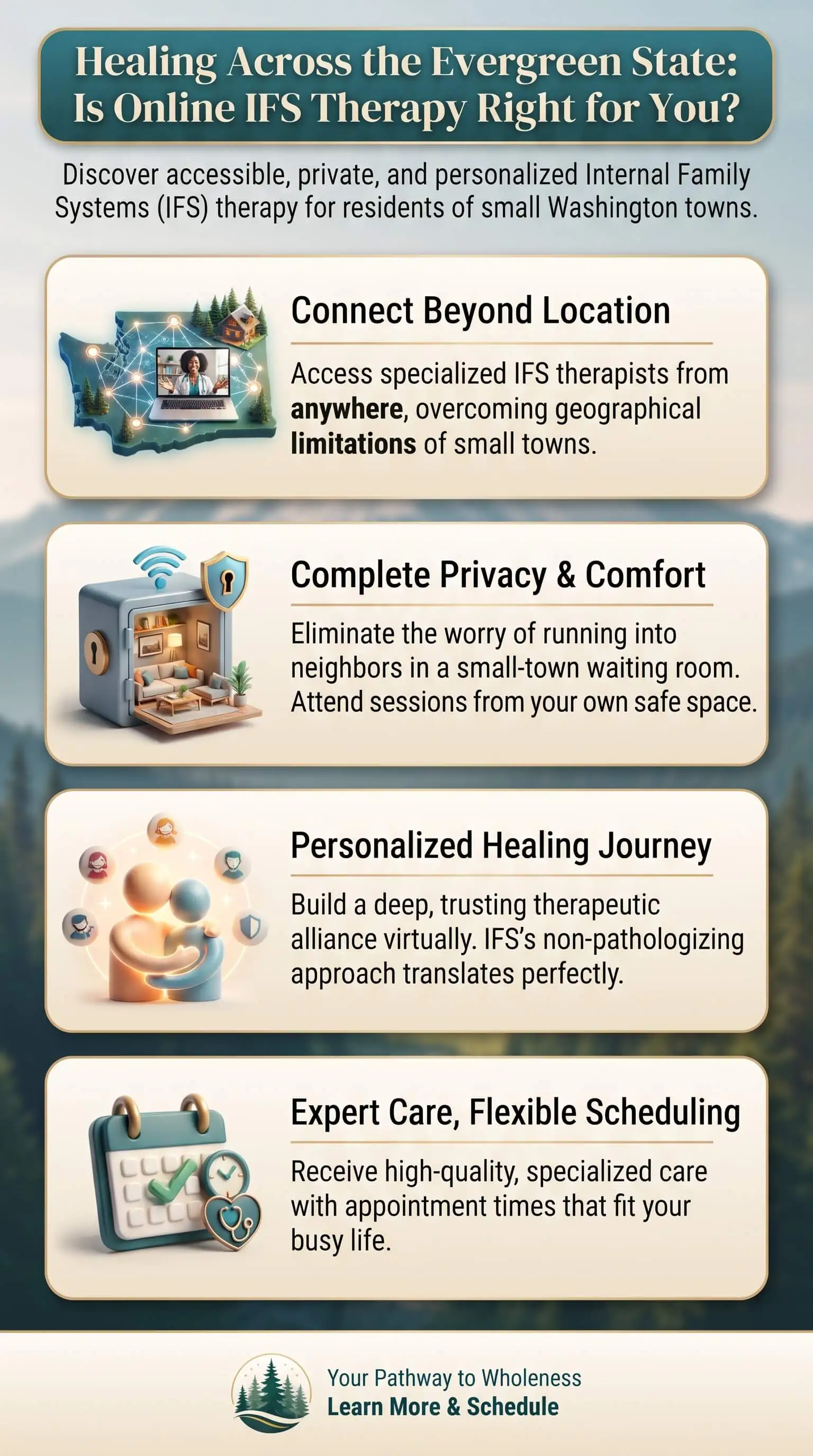
For most small-town residents, online sessions come out ahead on time, privacy, and keeping a steady rhythm. The drive wins mainly when home has no private corner at all.
Online IFS from home:
Time per session: about 50 minutes
Who sees you go: nobody
Winter weather: doesn't touch it
Keeping a weekly rhythm: easy to protect
Travel costs: none
Where you feel safest: your own space, which often helps
Driving to an in-person IFS therapist:
Time per session: 50 minutes plus anywhere from 1 to 5 hours on the road
Who sees you go: neighbors, the parking lot, the waiting room
Winter weather: pass closures and black ice cancel sessions
Keeping a weekly rhythm: hard to keep up for months
Travel costs: fuel and time off work, sometimes a night away
Where you feel safest: an office you've never sat in
When Online IFS Isn't The Right Fit
Online IFS isn't the right call if you're in immediate danger. In that case, call or text 988, or dial 911.
It also struggles when there's truly nowhere private to talk, and it can't happen while you're out of state. A therapist can only practice where they hold a license. If you're on a hunting trip in Idaho on a Tuesday, that week's session moves.
Some needs fall outside what a given therapist offers. Lauren Rath works with adults only and doesn't see children, teens, couples, or anyone in active substance use. That's about fit, and it says nothing about you.
Cost deserves a straight look too. Anyone who has priced out the real cost of specialized care knows it adds up. Check your insurance first. Many Washington plans cover telehealth therapy, and if you pay out of pocket, you're entitled to a written Good Faith Estimate before anything starts.
A Word From An IFS Therapist Who Works By Video
Lauren Rath, MA, LMHC, is a licensed Mental Health Counselor in Washington. She trained in Internal Family Systems through the IFS Institute and has practiced IFS for seven years. From Spokane, she sees adults all over the state by telehealth, including people in towns where the nearest IFS-trained therapist is a three-hour drive away.
"People arrive braced. They're expecting a verdict about what's wrong with them, and instead a part of them gets listened to for the first time in thirty years. Then the whole system exhales. I've watched it happen on a screen from four hundred miles away."
Essential Resources
Where to look next, if you're still deciding from a small town.
Check Any Therapist's License Before The First Call
Washington's Department of Health lets you look up a provider's credential, status, and disciplinary history by name. It takes about a minute. Do it for anyone you're weighing, including the one you like best.
Source: Washington State Provider Credential Search
Confirm Someone Is Actually Trained In IFS
Plenty of profiles mention parts work. The IFS Institute, which Richard Schwartz founded, trains and certifies IFS therapists, and its directory lists the people who've been through that training.
Source: IFS Institute Find A Professional
Find Out Whether Your Address Sits In A Shortage Area
Type in your address, and HRSA's tool tells you whether you live inside a federally designated mental health shortage area. If the local waitlist has ever felt endless, this usually explains it.
Source: HRSA Find Shortage Areas By Address
Learn How Telehealth Works When You Live Far Out
A short federal guide written for rural patients. It covers how to get ready for a visit and mentions Lifeline, a program that can help with phone and internet costs.
Source: Telehealth For Rural Communities
See What Behavioral Health Telehealth Covers
A plain rundown of the kinds of mental health care available by video and text, plus a nudge to ask your provider whether a virtual visit suits you.
Source: How To Use Telehealth For Behavioral Health Care
Find Free Peer Support Near You Or Online
NAMI affiliates in Kittitas, Walla Walla, Jefferson County, and well beyond run free support groups, many of them on Zoom. They're useful alongside therapy, and while you wait for it.
Source: NAMI Programs In Washington
Know What Happens If You Reach Out Tonight
The 988 Lifeline walks through what a call, text, or chat actually involves, from who picks up to what they'll ask first. Knowing the shape of a thing makes it easier to do.
Source: What To Expect From The 988 Lifeline
Supporting Statistics
The numbers behind why distance decides so much in Washington.
Most Of The State Runs Short On Mental Health Providers
Washington's 2018 State Health Assessment reported that the federal government had designated 35 of the state's 39 counties as Mental Health Professional Shortage Areas.
Only King, Pierce, Snohomish, and Thurston went without a designation in 2017.
In 2016, 17 counties had no psychiatrist reporting direct patient care. If you've struggled to find anyone at all, let alone an IFS specialist, the gap was there long before you went looking.
Source: Washington State Health Assessment: Access To Behavioral Health Providers
Rural Washington Has Long Had A Fraction Of The Clinicians
A 2006 study in the Journal of Rural Health used Washington licensing data and found that urban areas had 3 times the psychiatrist full-time equivalents per 100,000 people compared with rural areas, plus more than 1.5 times the other mental health providers.
More than 80% of rural service areas fell at least 10% below the state's provider ratio.
The study is two decades old. The state's own county counts above suggest the shape hasn't changed much.
Source: Modeling The Mental Health Workforce In Washington State
Rural Patients Use Telehealth Far Less, Even For Mental Health
AHRQ's Medical Expenditure Panel Survey found that between 2021 and 2023, 26.3% of mental health visits happened by telehealth for people outside metro areas, against 48.9% for people inside them.
The people with the fewest local options are the least likely to be using the one that cuts out the drive.
Among privately insured patients, the gap grew wider, at 21.7% rural and 53.4% metro.
Small rural areas came in at 30.9%, a bit above large rural areas at 24.7%.
Some of the gap is about connection. A good share of it is simply not knowing the option exists.
Source: AHRQ Statistical Brief #570: Use Of Telehealth In Nonmetropolitan And Metropolitan Areas
Final Thoughts And Opinion
Distance shouldn't decide what kind of help you get. For a long time, it did. Living three hours from a healthcare specialist meant taking whoever was in town or going without, and a lot of people went without.
I expected the screen to water the work down. Seven years in, it hasn't. Whatever passes between two people paying close attention seems to make it through a camera more or less intact.
What caught me off guard was privacy. For people in small towns, a session at home can feel safer than any office. Nobody clocks the car outside, and nobody sees your face on the way out. A part of you that would never let you walk through a door on Main Street will sometimes let you open a laptop at the kitchen table.
Four things I've stopped being surprised by:
The person who almost didn't book the call is often the one who settles in fastest.
People apologize for crying. Every time.
A parked pickup makes a better therapy room than anyone believes until they try it.
The part most worried about being found out is usually the one that's been protecting you the longest.
Here's an opinion I'll own. When someone asks whether this is worth it, a protective part is often asking whether they're worth the trouble.
You are. The drive was never what stood in the way, and the screen just makes that easier to see.
Frequently Asked Questions
Q: Does Online IFS Therapy Work As Well As In Person?
A: For many people, yes. IFS focuses on what's happening inside you, so the physical room carries less weight than you'd assume, and some people go deeper at home than they ever would in an office. Research on IFS is still young, and a good therapist will be upfront about that.
Q: Do I Have To Live In Washington, Or Just Be Here During Sessions?
A: What counts is where you physically are during each session. A therapist licensed in Washington can only meet with you while you're in the state. If you'll be away on a session day, reschedule.
Q: What If My Internet Is Spotty?
A: Ask at the start what happens if the video cuts out. Many therapists finish by phone or pick up where you left off. Sitting near the router helps, and so does a wired connection. A connection that mostly holds is enough.
Q: Will Anyone In My Town Know I'm In Therapy?
A: Going online removes the most visible signs, since there's no waiting room and no car parked outside an office. The weak spots are insurance statements mailed home and anyone who might overhear. Headphones, a closed door, or a parked car handle most of it.
Q: Does Insurance Cover Telehealth Therapy In Washington?
A: Many plans do. Lauren Rath Therapy is in-network with BCBS, Aetna, Regence, Premera, and Cigna. Paying out of pocket, you're entitled to a written Good Faith Estimate before care begins. Call your plan, or ask your therapist to help you check.
Q: How Do I Confirm A Therapist Is Licensed And IFS-Trained?
A: Look them up in the Washington State Department of Health's Provider Credential Search, then check the IFS Institute's directory for their training. Both are free and take a few minutes.
Q: Is Online IFS Safe For Trauma Work?
A: It can be. IFS moves at the pace your parts allow, and nothing gets opened before you're ready. Talk early about how you'll settle yourself after a session ends, since you won't have a drive home to do it. If you're in crisis, call or text 988 first.
Take The First Step
Reaching out from a small town asks more of a person than it looks like from the outside, and some part of you may already be talking you out of it. That part is doing its job.
Whenever you're ready, one sentence is plenty to start. Book a free 15-minute call with Lauren Rath Therapy from your kitchen table, your truck, or anywhere the door closes, and see how it feels.
[ Book A Free 15-Minute Call ] Free, 15 minutes, no pressure.


